

For dentists
Our approach is simple: we are truly passionate about our work. If you are passionate about yours, we would love to work with you to achieve consistently great outcomes for your patients.
Advice before you begin
We work with dentists of every level of experience, from the newly qualified to highly experienced specialists, and tailor our service to each: expert technical advice, guidance and top quality laboratory work at every step.
Close communication and teamwork between the dentist and the laboratory can prevent costly mistakes and unnecessary extra chair time, and keep outcomes consistently successful. We advise on questions like these:
- From the models on a semi-adjustable articulator, are there functional issues to address before a planned course of cosmetic or aesthetic treatment?
- Which material gives the aesthetic outcome you want while keeping the strength the case needs: porcelain bonded to precious metal, pressable disilicate glass or milled zirconia?
- What is the ideal tooth preparation for veneers, or for posterior all-ceramic restorations?
- What is the technically ideal order in which to carry out a complex rehabilitation?
Communication
Good communication is at the heart of every successful relationship, and we take it seriously. Phone us, or email digital photographs to discuss a forthcoming case. It lets us give the right technical advice up front, so you can prepare correctly for each step of the treatment plan.
We find digital photographs extremely useful and encourage them for every case. Email them to admin@visiondentalab.com with the patient's name in the subject line.
- Phone
- 01573 226569
- admin@visiondentalab.com
- Address
- Sydenham Cottage, Edinburgh Road, Kelso TD5 7EN
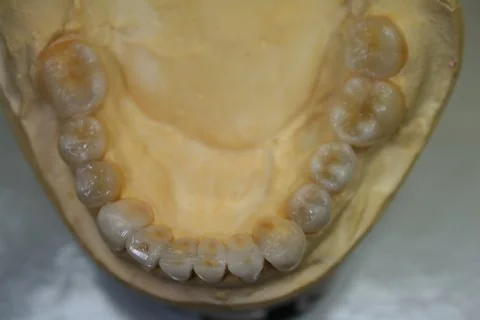
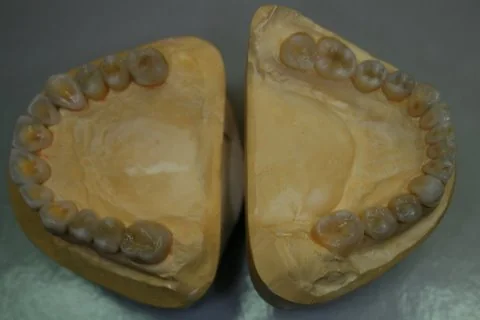
Diagnostic wax-ups
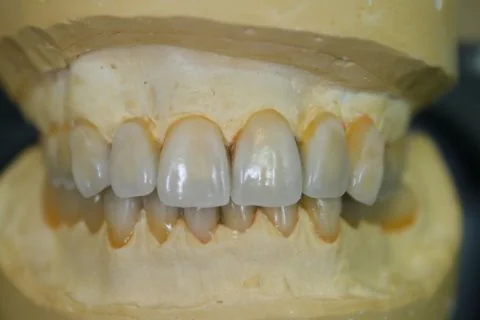
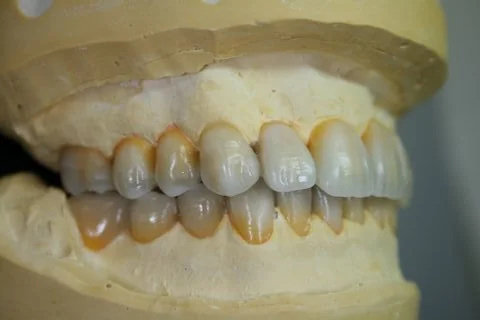
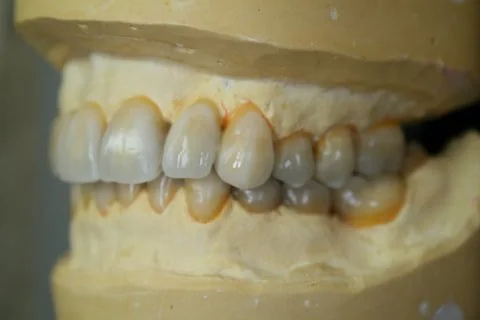
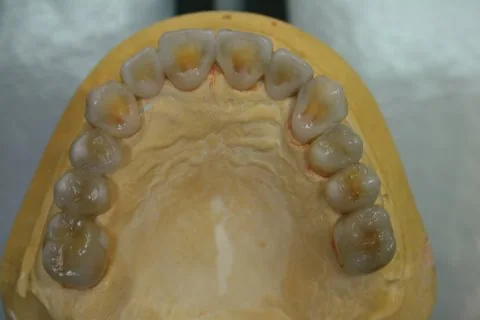
A diagnostic wax-up is a relatively inexpensive way to secure the functional and aesthetic success of many kinds of treatment, not only complex cases. Besides confirming that a planned treatment is technically feasible, it:
- Shows any functional treatment needed for long-term success. Before crowning the front teeth for cosmetic reasons, for example, it may be necessary to open the bite and stabilise posterior support.
- Lets us advise, early, on the most suitable material and preparation for the planned treatment.
- Gives the patient a realistic idea of how the final restoration will look and function, which sets realistic expectations.
- Can be used to make a matrix for the temporary restoration and to make preparation guides. The temporary can then be assessed in the mouth, and any changes carried into the final restoration.
Guides we share
Our original site offered these guides to dentists. Ask us for a copy.
- Impression trouble-shooting guide
- Shade taking guide
- Making occlusion work, parts 1 and 2
- Making better impressions
- An improved veneer preparation technique
- Choosing and using permanent luting cements
- All-ceramic preparation guide
- All-ceramic chairside preparation guide